
Photos and review by ALYSON CAMUS
LOS ANGELES – Nostalgia is overrated and we can never truly go back to the past. However, it’s hard not to feel nostalgic when someone like Paul Simon – who has been a constant presence in our collective musical consciousness since the ‘70s – announces a tour.
Simon announced his retirement in 2018, following his farewell tour (Homeward Bound) and three fantastic nights at the Hollywood Bowl. At that time, he spoke candidly about his hearing loss, and we all thought he was done with touring. As a perfectionist, he was convinced his hearing loss would prevent him from ever performing live again with a band. So, I was certain I would never see him on stage again. That’s why this current quiet celebration tour felt like a surprise –a little miracle that almost didn’t happen.

We can never return to the past, and we will never again be able to attend Simon’s 1991 concert in Central Park. I had the chance to be there, and it remains one of the most amazing musical experiences of my life. It would have been completely unrealistic to walk to Walt Disney Hall on Friday night expecting to relive that same bombastic and sonically overwhelming experience: Simon is now 83 and his voice has become a much softer instrument, one that vacillates far more than it once did. But as he made his way through the night, the nuances and unexpected quivers became part of the performance, a subtle reflection on life, love and the inevitable passage of time.
Simon took the stage at Walt Disney Hall with his ten-piece band around 8:30 pm, ready to deliver a memorable night of delicate compositions and timeless tunes. All smiles, Simon looked happy to be there, especially considering the “hectic past two weeks” as he described them. He had recently canceled two concerts in Philadelphia at the end of June due to chronic and intense back pain, and his Long Beach performance was postponed by one day following a minor surgical procedure to address his back pain issue. “This is the first opportunity I had to play with my band since before COVID” he told the crowd. “We are very grateful.”

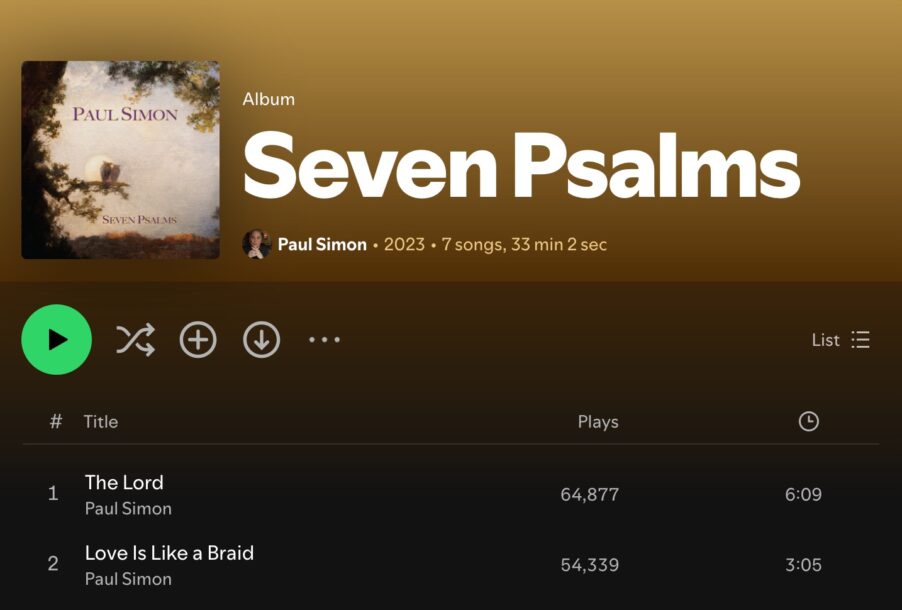
He explained that the show would be divided into two parts: the first featuring songs from his last album, “Seven Psalms,” followed by a short intermission. After the break, he and his band would return to the stage to perform “a bunch of hits” – classic Paul Simon songs and even a few Simon and Garfunkel favorites, and some deep cuts from his long and rich catalog.
Very few people, including myself, seemed familiar with the new material, a series of meditative songs reflecting on life, love and the state of the world. But it didn’t really matter. These sophisticated musical pieces certainly warrant deeper listening, yet the audience appeared captivated, listening in near-complete silence. This first part of the show felt like a truly contemplative experience, and the fragility of Simon’s voice matched the eerie, introspective atmosphere. A pure emotional undercurrent was palpable as his acoustic guitar, paired with the subtle musical arrangements provided by the ensemble of musicians around him, crafted a genuinely unique and intimate experience.

Sitting on a stool at center stage, he opened with “The Lord,” a deeply meditative piece whose lyrics carry the weight of the New Testament – revealing how much the singer-songwriter is reflecting on his spirituality at this stage of his life. His voice has become a soft and vulnerable vibrato, no more than a whisper at times, yet its tone remains unmistakably his.
He cracked a joke about cows during the more upbeat “My Professional Opinion,” a low-key, bluesy-country tune that briefly energized the crowd, but the overall tone of the set remained solemn and biblical in nature.
Simon has referred to “Seven Psalms” as an “argument I’m having with myself about belief or not.” In an interview, he shared that the album’s title came to him in a dream –and the rest unfolded as a journey of discovery.

The 33-minute, seven-movement interconnected composition is meant to be heard and performed as one continuous piece of music. It’s a deeply personal work, with a recurring motif, “The Lord,” weaving through the movements, while existential questions fill the lyrics, occasionally laced with dry humor: “The Lord is a puff of smoke/ That disappears when the winds blow”… “The Lord is my engineer/The Lord is my record producer.”
“I have my reasons to doubt/The white light eases the pain/Two billion heartbeats and out/Or does it all begin again?” Simon asks in “Your Forgiveness” during which the flute, violin and cello particularly shone.
“Trail of Volcanoes” featured beautiful Spanish guitar work with intricate patterns, underscoring the song’s reflection on the world and human destiny: “Now those old roads are a trail of volcanoes/Exploding with refugees/It seems to me/We’re all walking down the same road/To wherever it ends.” The song was one of the most poignant tracks of the first set, partially evoking Simon’s long history of world music exploration, but now delivered with greater gravitas.
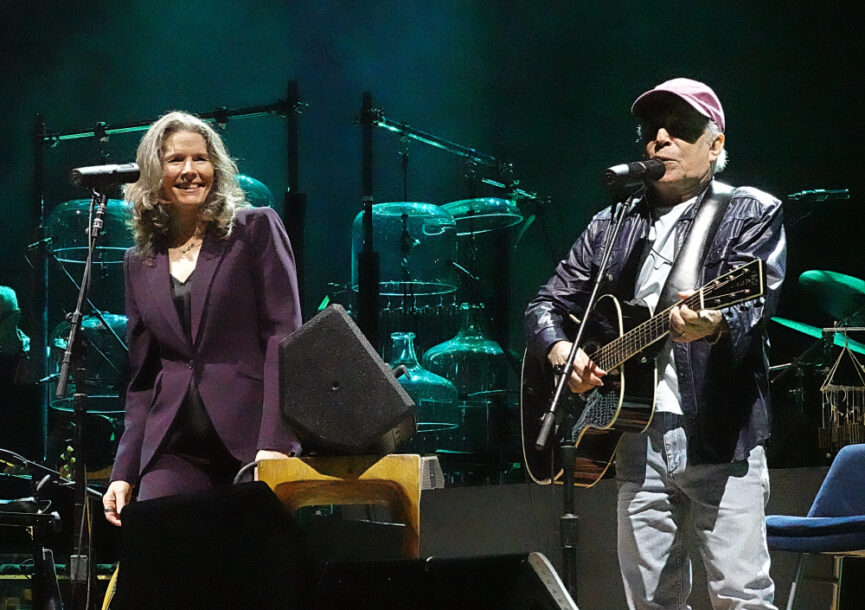
His wife, singer songwriter Edie Brickell shared the lead vocals on “Sacred Harp,” elevating the melodies with her clear and youthful falsetto, occasionally blending in beautiful harmony with Simon’s voice.
The set closed with “Wait,” a haunting piece layered with harmonies and lyrics that ruminate on mortality and the mystery of what comes next: “Life is a meteor/Let your eyes roam/Heaven is beautiful/It’s almost like home.”
It would be incomplete to reflect on the first part of the show without mentioning the impressive musicianship of the band, which crafted delicate acoustic arrangements around Simon’s emotional compositions – each marked by technical prowess and masterful precision. To say that Simon assembled a remarkable ensemble would be an understatement. The band included guitarists Mark Stewart, Gyan Riley, and Biodun Kuti; longtime bassist Bakithi Kumalo – the last surviving member of the original Graceland band; flutist Nancy Stagnita; cellist Eugene Friesen; and the legendary drummer Steve Gadd.

The second part of the show was a fantastic crowd-pleaser, featuring 16 songs spanning Simon’s long career, including a few beloved Simon & Garfunkel tunes. But that didn’t mean it was all hits – far from it. Simon returned to the stage in a different outfit—a baseball cap and a jacket—signaling a shift in both style and tone.
The setlist blended deep cuts like “The Late Great Johnny Ace” and “René and Georgette Magritte with Their Dog After the War” with crowd favorites such as “Slip Slidin’ Away” and “Homeward Bound.” It opened with a relatively subdued version of the legendary “Graceland,” which, even without Simon reaching all the original high notes, lifted the crowd’s spirits and had feet tapping across the hall.
Many people sang along during “Slip Slidin’ Away,” which – like several other songs – had been reworked to suit Simon’s softer vocal delivery. He playfully teased the audience before launching into “Homeward Bound,” strumming the intros to a few different songs after announcing, “This is a song from the Simon & Garfunkel days.”
The set also featured rarer tracks, including “The Late Great Johnny Ace” (from Simon’s 1983 album “Hearts and Bones”), a song inspired by the deaths of R&B singer Johnny Ace, President John F. Kennedy, and John Lennon. As the piece concluded with a haunting coda by Philip Glass, images of all three Johns were projected on the screen.

“St. Judy’s Comet,” a lullaby written for his eldest son, was a touching moment, especially as a photo of Paul and young Harper appeared on the screen while the beautiful flute arrangements gently faded at the song’s end. During the encore, Paul dedicated “Father and Daughter” to his daughter Lulu, who, he said, was in attendance.
Since it was truly a family affair, Edie Brickell returned to the stage to harmonize during Graceland’s “Under African Skies,” a part originally recorded by Linda Ronstadt. Simon dedicated the song to the late Joseph Shabalala, the founder and musical director of the choral group Ladysmith Black Mambazo, that was such a big part of “Graceland.” Later, Edie also playfully appeared to whistle at perfection the famous melody of “Me and Julio Down by the Schoolyard,” accompanied by some lighthearted dance moves.
“René and Georgette Magritte with Their Dog After the War” was also featured among the deep cuts. Simon introduced the song with a little story: he found the inspiration while looking at a book about the famous Belgian Surrealist artist, pausing on the photo that shares the song’s title. He joked, “That’s a number one song!” Violin, cello, and vibraphone shone throughout the piece.
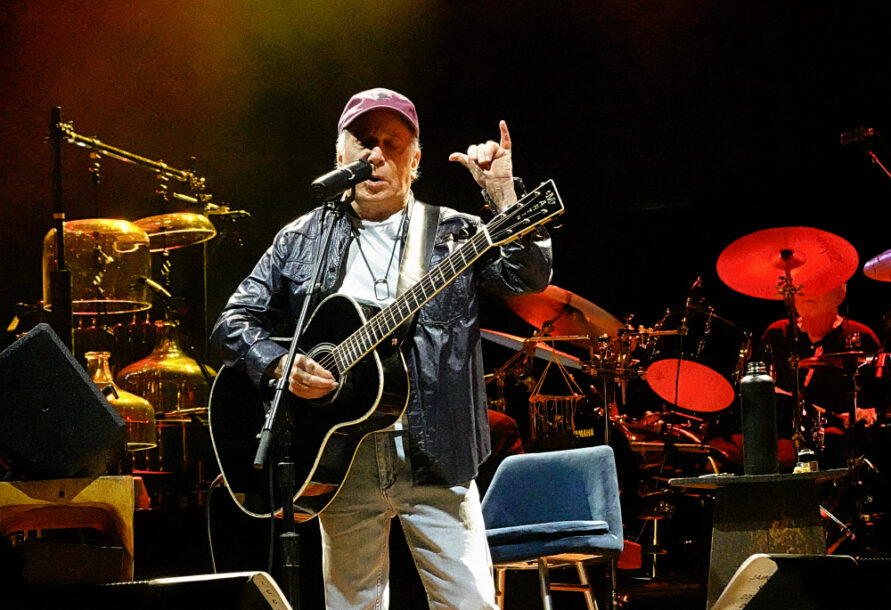
He truly revisited his catalog with the playful “Rewrite” (from his 2011 album “So Beautiful or So What”) and two gorgeous tracks from the 1990 masterpiece “The Rhythm of the Saints”: “Spirit Voices” and “The Cool, Cool River.”
The encore brought even more excitement with the 1975 hit “50 Ways to Leave Your Lover,” a song recorded just before Steve Gadd became one of the most in-demand drummers. Although some of the songs now require more vocal power than Simon can provide, it was a delight to hear these classics, especially as the audience eagerly helped him out during the most famous pieces.
No one can imagine a Paul Simon return to the stage without closing with his two most beloved songs: “The Boxer” and “The Sound of Silence.” As expected, the audience took over during the “lie-la-lie” choruses, and when Simon left the stage one last time, he made it clear he still had one song left.
Indeed, he always closes with “The Sound of Silence,” and this time was no exception. He has probably performed this 60-year-old song hundreds, if not thousands, of times, but this breakthrough hit launched Simon and Garfunkel’s career and defined a sound that still resonates today. The audience was at its quietest, and the magic was still palpable. Maybe, just for the duration of a song, you can go back to the past.

Setlist
Set 1: “Seven Psalms”
The Lord
Love Is Like a Braid
My Professional Opinion
Your Forgiveness
Trail of Volcanoes
The Sacred Harp (with Edie Brickell)
Wait (With Edie Brickell)
Set 2:
Graceland
Slip Slidin’ Away
Train in the Distance
Homeward Bound (Simon & Garfunkel song)
The Late Great Johnny Ace
St. Judy’s Comet
Under African Skies (with Edie Brickell)
Rene and Georgette Magritte with Their Dog After the War
Rewrite
Spirit Voices
The Cool, Cool River
Me and Julio Down by the Schoolyard (with Edie Brickell)
Encore:
Father and Daughter
50 Ways to Leave Your Lover
The Boxer (Simon & Garfunkel song)
The Sound of Silence (Simon & Garfunkel song)
Listen to Seven Palms: